
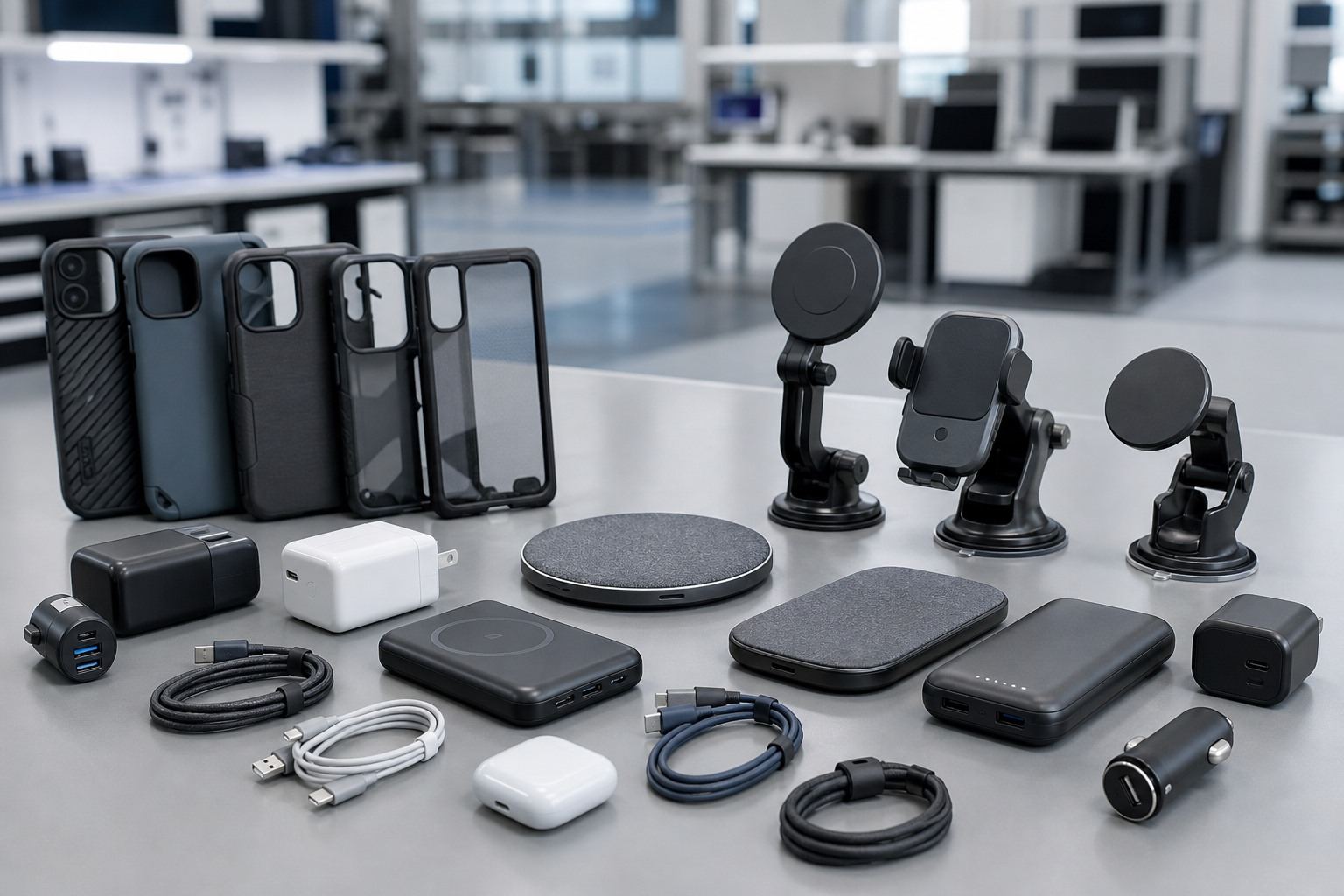
Phone accessories are easy to list online but difficult to source consistently. Two products can look identical in a photograph while using different plastics, connectors, chips, magnets, adhesives, coatings, or internal protection components. Those differences affect compatibility, charging speed, heat, durability, customer reviews, returns, and product safety.
China offers a broad phone accessories supply chain, from ready-stock products to custom tooling and private-label packaging. The sourcing challenge is to match the product category with the right manufacturer, define measurable specifications, and control every production batch against an approved standard.
What different buyers care about most
Importers and wholesalers
Importers usually prioritize reliable capacity, competitive landed cost, product compliance, repeat-order consistency, mixed-SKU planning, carton efficiency, and supplier accountability. They need products that can survive distribution and remain stable across several orders, not just an attractive first sample.
Ecommerce and marketplace sellers
Amazon, Shopify, and marketplace sellers are highly exposed to customer reviews and return rates. Their key concerns include device compatibility, listing accuracy, packaging size, barcode application, variation management, low or staged MOQ, inventory replenishment, fulfillment preparation, and fast corrective action when defects appear.
Private-label brands
Brands need differentiation without losing control of cost and lead time. Their priorities include custom colors, tooling, materials, finish, logo durability, packaging experience, intellectual-property protection, product testing, compliance, and a supply plan that can support future versions.
Affiliate marketers and content publishers
Affiliate marketers may not own inventory, but product quality still affects audience trust and conversion. They need accurate performance claims, dependable samples for testing, stable product links, clear model differences, useful images and specifications, and a supplier or brand that can maintain stock. If an affiliate later launches a private-label product, review data can help define the first sourcing brief.
Major phone accessories product categories
Phone cases and protective products
Common products include TPU cases, hard PC cases, hybrid protective cases, silicone cases, wallet cases, waterproof housings, lens protectors, and screen protectors. Key variables include device fit, port and button access, wall thickness, drop protection, material hardness, yellowing, surface texture, print adhesion, magnet placement, camera clearance, and packaging cleanliness.
A case mold must match the exact phone model. Small dimensional errors can affect buttons, microphones, charging ports, cameras, wireless charging, and screen protection. Approve fit using genuine devices or controlled fixtures and keep a verified reference sample for production.
Charging cables and adapters
This category includes USB-C cables, legacy connector cables, data cables, fast-charging cables, braided cables, multi-connector cables, and adapter products. Appearance alone says little about performance. Buyers should specify connector type, cable length, conductor construction, supported power, data capability, e-marker requirements where applicable, bend durability, pull strength, shell construction, overmold, and packaging claims.
Test voltage drop, current, data function, connector fit, temperature, bending, and repeated insertion according to the intended product. Marketing terms and USB logos must be used accurately. USB-IF states that certified logos are for qualified products and licensed companies, so buyers should verify claims rather than copying logos from a supplier's sample.
Wall chargers and car chargers
Chargers may differ in output ports, total power, power distribution, protocol support, semiconductor design, plug type, housing material, thermal control, protection functions, and internal construction. Important checks include rated input and output, charging protocols, load performance, efficiency, temperature rise, abnormal conditions, port behavior, plug dimensions, assembly, labeling, and destination-market compliance.
Do not approve a charger only because it charges one phone. Test it with relevant devices, cables, loads, and port combinations. Confirm whether power claims apply to one port or total output and whether performance changes when several ports are used.
Wireless chargers and magnetic accessories
Wireless charging products include pads, stands, vehicle mounts, multi-device stations, and magnetic charging accessories. Buyers should control coil position, charging stability, foreign-object behavior, heat, power input, surface materials, indicator lights, magnet strength, alignment, case compatibility, and included cable or adapter requirements.
Claims relating to platform compatibility or certification should match the exact model. Changing a coil, magnet layout, component, firmware, or power configuration after testing may affect performance and documentation.
Power banks and battery products
Power banks create additional safety, transport, and compliance responsibilities. Specify cell type and source, rated and typical capacity, output, input, protocols, cycle performance, protection functions, housing, display accuracy, temperature behavior, and labeling. Confirm battery transport documentation and destination requirements with qualified providers.
Capacity claims should be explained correctly because cell capacity and usable output capacity are not identical. Misleading capacity claims can produce poor reviews, returns, and marketplace action.
Stands, holders, and vehicle mounts
Desktop stands, ring holders, grips, magnetic mounts, vent mounts, dashboard mounts, and bicycle mounts depend on mechanical stability. Test hinge torque, adhesive performance, suction, clip strength, magnet holding force, vibration, surface protection, adjustment range, device weight, case compatibility, and durability after repeated use.
Vehicle conditions can include heat, cold, sunlight, vibration, textured dashboards, and different vent designs. A sample tested only on a clean office desk may not represent real use.
Audio and content-creation accessories
Earphones, microphones, remote controls, lights, tripods, and creator accessories require category-specific testing. Evaluate sound, latency, connection stability, controls, battery runtime, noise, mounting strength, light output, color consistency, app behavior, and included accessories. Wireless products may be subject to radio-equipment requirements in the destination market.
Factory, specialist assembler, or trading company?
The right supplier model depends on the category. A phone case factory may specialize in molding, printing, coating, and device fit. A charger supplier needs electronics engineering, component control, assembly, aging tests, and safety-related testing. A trading company may be useful for mixed categories, smaller quantities, consolidation, and one packaging standard across several products.
Ask suppliers which processes are completed in-house, which are subcontracted, who controls key components, and whether the quoted product is standard stock or built for your order. Verify the registered business, factory address, product focus, production equipment, testing capability, quality staff, export history, and responsibility for nonconforming goods.
Build a specification that prevents substitution
A quotation should be based on measurable requirements. Record the exact compatible device, dimensions, materials, weight, components, functions, power ratings, protocols, colors, finish, logo, packaging, labels, accessories, tests, and destination market. Identify which items cannot change without written approval.
For electronic accessories, use a bill of materials or controlled component list where appropriate. For cases and mounts, drawings and tolerance points may be more useful. A physical approved sample should support the written specification, not replace it.
Sample approval for ecommerce and import programs
Separate an attractive sales sample from a production-ready approval sample. Test several units where possible and record results. For ecommerce listings, use the approved product to create accurate dimensions, weights, compatibility statements, package contents, instructions, and photographs.
Before approval, check:
- Exact phone model and operating-system compatibility
- Materials, dimensions, weight, finish, and color
- Function under normal and demanding use
- Heat, charging, connection, or mechanical stability as relevant
- Logo size, position, color, and durability
- Retail packaging, inserts, warnings, labels, and barcodes
- All accessories and claims shown on the listing
Quality checks by product type
Inspection should combine general workmanship with product-specific tests. A single visual checklist is not enough for every accessory.
- Cases: device fit, buttons, ports, camera clearance, material, warping, print, magnet placement, yellowing risk, and drop-related construction.
- Screen protectors: dimensions, edge shape, clarity, coating, adhesion, bubbles, dust, accessory kit, and clean packaging.
- Cables: charging and data capability, voltage drop, connector fit, length, bend points, pull strength, e-marker or protocol behavior where applicable.
- Chargers: output under load, port combinations, protocol behavior, temperature, labeling, plug construction, assembly, and protection functions.
- Wireless chargers: alignment, charging stability, heat, magnet strength, case compatibility, indicator behavior, and included power requirements.
- Power banks: capacity verification, input and output, protocols, temperature, protection, display, cells, labeling, and transport documentation.
- Mounts: holding force, hinge torque, adhesive or suction performance, vibration, adjustment, repeated use, and surface protection.
Agree on sampling, defect classifications, acceptance criteria, test equipment, and failure handling before production. For higher-risk electronics, production testing and accredited laboratory work may be required in addition to pre-shipment inspection.
Compliance and marketplace risk
Requirements vary by product, function, battery, wireless capability, and destination. Electrical safety, electromagnetic compatibility, radio equipment, restricted substances, waste labeling, energy rules, battery transport, packaging, and consumer information may apply. Buyers should confirm the applicable route with qualified compliance professionals.
Do not accept a certificate because the supplier name or product photograph looks similar. Confirm that reports and declarations cover the exact model, ratings, components, plug, wireless function, battery, and construction being purchased. The European Commission notes that CE marking follows the applicable conformity-assessment process; it is not a generic certificate purchased for a product category.
Trademark and platform claims also require control. USB-IF logos, wireless-charging marks, phone-brand names, connector terminology, and compatibility statements may be protected or subject to usage rules. Do not print logos or claims until the right to use them has been verified.
Private-label packaging that reduces returns
Packaging should protect the product and prevent customer confusion. Clearly state compatible models, package contents, power requirements, key limitations, instructions, warnings, and business information required for the destination. Avoid claims that the product cannot consistently achieve.
For ecommerce fulfillment, control barcode placement, scan quality, SKU labels, carton quantities, suffocation warnings where applicable, bundle assembly, insert orientation, package dimensions, and carton marks. Smaller packaging can reduce fulfillment and freight costs, but it must still protect connectors, glass, coatings, and retail presentation.
Common buyer pain points and practical solutions
High return rates caused by compatibility
Solution: define exact models, test real devices, separate similar-looking variants, and write packaging and listings from the approved sample.
Performance changes after the first order
Solution: control key components and materials, prohibit unapproved substitutions, retain reference samples, and repeat inspections for reorder batches.
Low price but inconsistent quality
Solution: compare total landed and return cost, not unit price alone. Review the bill of materials, testing, defect history, packaging, and supplier response process.
Too many SKUs and difficult inventory planning
Solution: start with a focused compatibility range, use staged quantities, standardize packaging components, and track sales and returns before expanding variations.
Samples look good but mass production fails
Solution: approve a production-representative sample, document every critical requirement, monitor key production stages, and inspect before shipment.
Affiliate content loses audience trust
Solution: test the exact retail model, disclose important limitations, avoid unsupported performance claims, and update content when product versions or links change.
Phone accessories RFQ checklist
- Product category and exact compatible phone models
- Materials, dimensions, weight, colors, finish, and construction
- Power, data, protocol, battery, magnet, or mechanical requirements
- Order quantity by SKU and expected reorder volume
- Logo, custom color, tooling, and private-label requirements
- Retail packaging, inserts, labels, barcode, and fulfillment preparation
- Destination country and compliance responsibilities
- Sample tests, inspection criteria, and required reports
- Production deadline, shipping method, and target delivery date
How REGAL Sourcing supports phone accessories buyers
REGAL Sourcing helps buyers match each phone accessory category with suitable suppliers, compare quotations on the same specification, coordinate samples and private-label packaging, follow production, inspect goods, consolidate SKUs, and prepare export handover.
For ecommerce and brand projects, we focus on compatibility, listing accuracy, packaging, repeat-order consistency, and product-specific quality checks that can reduce avoidable returns. View our phone accessories OEM project, industry support, and complete sourcing services.
Frequently asked questions
What phone accessories can buyers source from China?
Common categories include cases, screen protectors, cables, chargers, wireless chargers, power banks, mounts, stands, audio accessories, creator products, cleaning items, and custom packaging.
How can buyers verify a supplier?
Check the registered company, product focus, production location, in-house processes, test equipment, component control, quality system, export experience, and ability to reproduce an approved sample.
What are the most important quality checks?
They depend on the category. Compatibility, function, heat, materials, dimensions, connection, charging performance, mechanical durability, artwork, packaging, labels, and barcode accuracy are common priorities.
Can suppliers support private-label products?
Many can support logos, colors, packaging, inserts, barcodes, bundles, and selected product changes. Confirm MOQ, tooling, lead time, testing, and compliance impact before approval.
Official references
Buyers can review current product and logo requirements through the USB-IF Compliance Program, the European Commission Radio Equipment Directive guidance, and the EU CE marking guidance. Requirements should be confirmed for the exact product and destination.